Bentonite Manufacturing in India: Why It Leads Global Markets
Walk into a foundry, drilling operation, or iron ore plant and bentonite is doing a very different job in each one. Yet the material behind these applications often comes from the same well-established Indian bentonite industry.
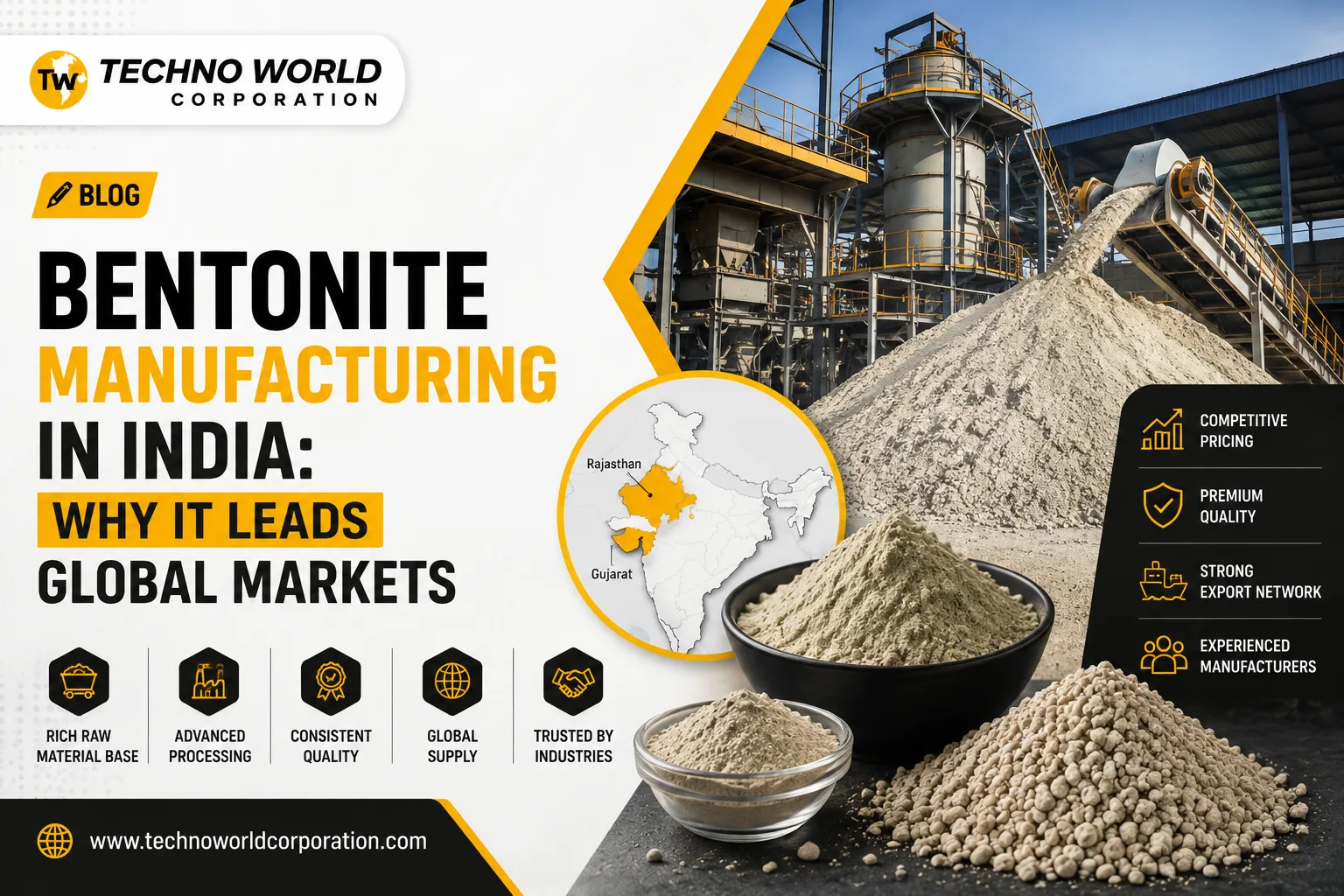
India has built a strong position in bentonite manufacturing because the country has the raw material, established mining regions, processing facilities, and manufacturers serving a wide range of industrial requirements. Gujarat and Rajasthan are particularly important to the domestic bentonite trade.
That strength is not based on clay availability alone. Processing quality, product consistency, application knowledge, supply capability, and access to export markets all matter once bentonite leaves the mine.
So, what has helped bentonite manufacturers in India compete in global markets? It starts with the country's resource base, but it certainly doesn't end there.
Why India Has a Strong Bentonite Base
Direct Pit-Head Raw Material Access
You cannot run a reliable processing plant on volatile raw material supply. India holds massive bentonite deposits across several key states, which gives local processing facilities a direct cost advantage over foreign mills that rely on imported crude clay.
Most of these reserves sit inside regions with long mining histories. Because processors draw directly from these established pits, they can select specific clay characteristics right at the pit-head. That keeps raw material costs predictable and protects factories from global shipping disruptions.
For any bentonite manufacturer, having a secure supply line changes daily operations. When incoming crude clay meets consistent swell and viscosity metrics, plant operators spend less time adjusting kiln temperatures or chemical additives, making it much easier to ship uniform orders to international buyers on time.
Why Gujarat and Rajasthan Drive the Sector
The country's bentonite production sits almost entirely within two states: Gujarat and Rajasthan. Key mining districts, notably Kachchh and Bhavnagar in Gujarat, alongside Barmer in Rajasthan, hold the vast majority of commercial reserves.
However, their dominance stems from more than raw tonnage underground. Decades of heavy extraction in these districts created a self-contained industrial ecosystem. Refining plants, specialized testing labs, bulk haulage fleets, and export logistics channels have all concentrated within a short radius of the pits.
For an industrial bentonite manufacturer, operating inside this established corridor simplifies daily business. Proximity to specialized ports like Kandla and Mundra keeps transport costs manageable, while ready access to experienced processing crews makes scaling up export shipments far more straightforward.
Processing Turns Clay Into a Product
Bentonite taken from a mine is not necessarily ready to go straight into an industrial process. It may need drying, grinding, activation, sizing, or other processing depending on the application.
This part of the industry is easy to overlook. A buyer is not simply purchasing clay; they are purchasing material with particular physical and performance characteristics.
A capable bentonite clay manufacturer therefore needs to understand what happens after extraction. Foundry applications, drilling fluids, pelletisation, construction, and sealing products do not necessarily call for the same grade or preparation.
Different Applications, Different Requirements
Consider sodium and calcium bentonite. Their behaviour is different, so their commercial uses are different as well.
A sodium bentonite manufacturer may focus on grades where swelling and sealing properties are important. A calcium bentonite supplier may serve applications where a non-swelling grade is more appropriate.
The same applies to product form. Depending on the customer's process, the requirement may be for processed clay, granules, or finely ground bentonite powder.
This ability to process and supply material for specific uses is an important part of India's manufacturing strength. The advantage is not simply having bentonite in the ground. It is being able to turn that resource into a product that an industrial buyer can actually put to work.
Competitive Processing and Pricing
India's advantage becomes clearer once bentonite moves beyond extraction. Processing facilities in established production regions allow manufacturers to prepare clay in different forms and grades without building the entire supply chain around imported material.
That local availability can also support competitive pricing. The final price still depends on grade, processing, packaging, transport, and order volume, so there is no single price advantage across every product. Still, access to domestic raw material gives a bentonite supplier India a useful starting point when competing for industrial orders.
Cost Meets Product Requirements
Competitive pricing only works when the material performs as expected. Industrial buyers are rarely looking for the cheapest clay available; they need a grade that works reliably in their process.
This is where established manufacturers can stand apart. Better control over sourcing and processing makes it easier to supply material according to defined specifications rather than selling one general-purpose grade to every customer.
Quality and Manufacturing Consistency
Price may attract an inquiry, but consistency is what keeps an industrial supply relationship going.
Bentonite can vary in mineral composition and performance depending on its source and processing. Manufacturers therefore need appropriate controls around raw-material selection, processing, grinding, sizing, blending, and final-product testing.
For a bentonite powder manufacturer, consistency becomes particularly important because fine powders are often supplied against specific customer requirements. Properties such as particle size, moisture, swelling behaviour, and other application-related characteristics can influence how the material performs.
Significance of Quality Control
A foundry cannot afford unpredictable bonding behaviour. A drilling operation needs material that behaves consistently in its fluid system. A sealing application has its own performance expectations.
That is why a dependable industrial bentonite manufacturer needs more than production capacity. It needs processes that keep the finished material within the agreed specifications from batch to batch.
India's Export Strength
Bentonite produced in India is not limited to the domestic market. Indian producers supply bentonite to buyers in other countries as well, in both processed and unprocessed forms.
Exporting the material, however, involves more than arranging a shipment. Overseas customers need the grade they specified, the right packaging, accurate product details, and delivery that fits their production schedule. A delay or variation in material quality can create problems well beyond the purchase itself.
Serving Overseas Industrial Buyers
This is where an experienced bentonite exporter India can make the process easier. International buyers generally look for a supplier that understands their specifications and can maintain the same product quality across repeat orders.
Indian manufacturers that have built export experience are better placed to handle these practical requirements. They can work with different product grades, packaging preferences, shipment sizes, and destination requirements.
That export capability has helped India's bentonite industry build a presence in overseas markets while giving international buyers another established source for industrial-grade bentonite.
What Makes Indian Bentonite Manufacturers a Practical Choice?
To see why Indian producers hold such a strong market position, you have to look at the entire supply chain as a single, connected system. It starts at the pit face with high-grade raw deposits, moves through specialized processing mills built for specific industrial grades, and runs straight through to established shipping channels. Heavy domestic demand from local foundries and steel mills keeps these operations running continuously, while mature export routes link plants directly to overseas buyers.
Running at this scale gives Indian mills real, hands-on experience across dozens of different industrial specifications and export regulations.
For international buyers, the real benefit isn't just finding another source of cheap raw clay; it's tapping into an established manufacturing infrastructure. A reliable Bentonite exporter India handles raw material selection, chemical processing, custom packaging, and port logistics under a single contract, eliminating the headaches of managing multiple middleman vendors.
Partner with the Right Bentonite Supplier
India has built a strong bentonite manufacturing base through its mineral resources, processing capabilities, product variety, and established export network. For buyers, though, the supplier still matters as much as the country of origin.
If you are looking for application-specific bentonite, consistent quality, or dependable supply, Techno World Corporation is a renowned brand in the market of Bentonite manufacturing India. Our team can help you evaluate the right material for your requirements. Contact our team to discuss your application and sourcing needs.
Popular Posts